
Main page content
UEi C165+ Combustion Analyzer Review: The Tech-in-the Truck Field Evaluation
Executive Summary
When you are kneeling on a wet concrete basement floor next to a sump pump on a Friday afternoon no-heat call, every tool in your bag has to earn its keep. The main question every service technician asks is simple: Will this analyzer help diagnose or fix heating problems faster, accurately, safely, and reliably, and does it pay for itself on the truck?
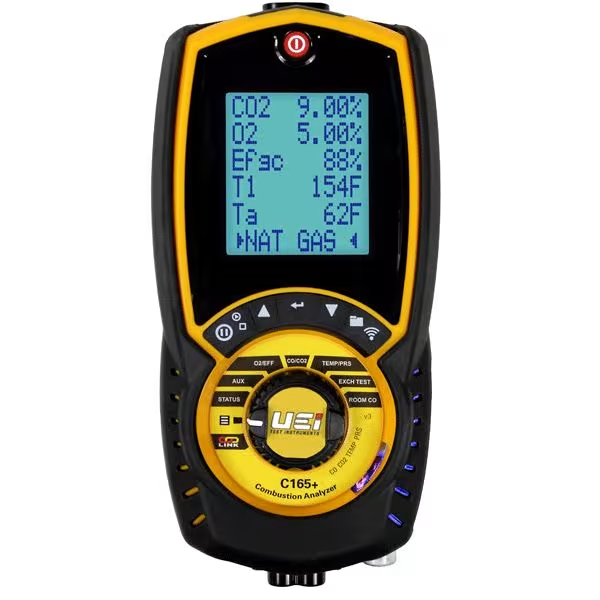
The UEi C165+ Combustion Analyzer answers that question by solving the biggest headaches technicians face with standard flue gas meters. Traditional electrochemical CO sensors burn out fast when you stick a probe into a rollout-damaged furnace or a soot-choked boiler. The Electro Optical Sensor (EOS) inside the C165+ reads carbon monoxide up to 10,000 parts per million (ppm) using an infrared beam instead of a chemical cell, while compensating for raw hydrogen gas. You can walk into a nasty, over-firing unit, read extreme CO levels without poisoning the meter, and watch it purge back to zero in seconds.
Combined with a 30-second startup countdown, built-in dual differential pressure ports, a dedicated heat exchanger test mode, and wireless PDF reporting through the UEi HUB app, the C165+ replaces multiple standalone gauges. For residential and light commercial technicians, it cuts setup time on every call and delivers rapid payback through saved labor and zero sensor replacement downtime.
AZ Testers Technician Score
Product rating on a scale from 1 to 10 based on field testing across primary diagnostic categories:
- Performance: 9.0 / 10
- Accuracy: 9.2 / 10
- Ease of Use: 8.8 / 10
- Durability: 8.5 / 10
- Features: 9.1 / 10
- Safety: 9.5 / 10
- Value: 8.9 / 10
Overall Score: 9.0 / 10
AZ Testers Recommended
- Best for: Residential and light commercial HVAC service technicians, boiler mechanics, and facility maintenance techs running daily tune-ups, fuel conversions, and safety inspections.
- Best feature: EOS optical CO sensor with hydrogen compensation rated to 10,000 ppm, preventing sensor poisoning and eliminating recurring cell replacement costs.
- Main weakness: Mechanical rotary selector dial can collect pipe dope or boiler soot around the bezel and needs periodic wiping.
- Upgrade path: Heavy industrial boiler specialists needing four-gas emissions testing (SO2, NO2) should step up to a dedicated industrial emissions analyzer.
Key Specifications At-A-Glance
The table below pairs manufacturer specifications with what those numbers actually mean when you are standing in front of an open burner compartment.
| Parameter / Spec | Manufacturer Specifications | Service Technician Field Impact |
|---|---|---|
| Oxygen (O2) Range | 0.0% to 21.0% O2, Accuracy: ±0.2% | Lets you dial in exact excess air and flame stability on atmospheric and power burners without sensor drift. |
| Carbon Monoxide (CO) EOS Sensor | 0 to 10,000 ppm with H2 Compensation, Resolution: 1 ppm | Survives extreme over-firing, blocked flues, and cracked heat exchangers without burning out a chemical cell. |
| Flue Temperature Range | 32°F to 1112°F (0°C to 600°C), Resolution: 0.1°F | Handles everything from 96% condensing PVC vents to high-temperature commercial steel flue stacks. |
| Differential Pressure Range | ±80 mbar (±32 inches water column) | Lets you clock gas valve manifold pressure and check flue draft on the same screen while adjusting the regulator. |
| Calculated Parameters | CO2, Excess Air, Combustion Efficiency, CO Air Free, Losses | Saves you from squinting at a laminated combustion slide chart with a flashlight in a dark mechanical room. |
| Field Upgradability | Nitric Oxide (NO) Sensor Expansion Slot | Allows you to add commercial NOx testing later without buying a brand-new combustion analyzer. |
| Power and Battery | Rechargeable NiMH / USB Charging, Up to 8 Hours Run Time | Runs through a packed winter dispatch schedule without hunting for an open basement outlet. |
| Mobile Integration | Wireless Bluetooth connection to UEi HUB Application | Attaches clean, timestamped PDF combustion reports straight to your digital work order before leaving the driveway. |
Model Comparison
Selecting the right analyzer depends on the equipment you touch every week. The table below compares the entry-level UEi C161, the core UEi C165+, and the commercial UEi C165+ NO Kit using real-world investment tiers based on billable service call equivalents.
| Feature / Capability | UEi C161 | UEi C165+ | UEi C165+ NO Kit |
|---|---|---|---|
| CO Measurement Range | 0 to 2,000 ppm | 0 to 10,000 ppm (EOS) | 0 to 10,000 ppm (EOS) |
| Hydrogen (H2) Compensation | No | Yes | Yes |
| Differential Pressure Testing | No | Yes | Yes |
| Heat Exchanger Test Mode | No | Yes | Yes |
| Nitric Oxide (NO) Upgradable | No | Yes (Field or Factory Option) | Pre-Installed NO Sensor |
| Target Application | Basic Residential Tune-Ups | Residential and Light Commercial | Commercial Boilers and Industrial NOx |
| Investment Tier (Service Call Equivalent) | Entry-Level Tier (Approx. 3 to 4 residential calls) | Mid-Tier Pro Investment (Approx. 5 to 7 residential calls) | Commercial Spec Tier (Approx. 8 to 10 commercial calls) |
Pro Tip for Commercial Technicians: Modulating-condensing boilers and commercial power burners run on tight excess air margins where minor air-shutter or gas-valve errors cause rumbling, soot, or high CO. Always log three separate operating points: High Fire, Low Fire, and Ignition. Hook the differential pressure ports up to check flue draft and gas manifold pressure at the same time as your stack sample. Most importantly, never power on and auto-zero your analyzer inside a tight mechanical room or utility closet where an atmospheric water heater might be backdrafting. Always step outside into clean ambient air for the 30-second zero cycle so your 20.9% oxygen baseline is dead-on.
What Problem Does This Product Solve?
Modern high-efficiency furnaces and modulating boilers do not forgive guesswork. Setting a gas valve by eye or guessing draft pull on a 96% condensing unit leads to fouled secondary heat exchangers, nuisance flame-sensor lockouts, and dangerous carbon monoxide production.
Without a multi-function analyzer, a technician has to haul a dedicated digital manometer, a draft gauge, two clamp thermometers, and a standalone CO safety meter down narrow basement stairs. Juggling three separate meters while kneeling next to a boiler slows down every call and increases the chance of leaving a tool behind.
Even worse is the constant fear of poisoning a standard electrochemical CO sensor. Every veteran tech knows that stomach-drop feeling of inserting a probe into a rollout-damaged furnace, watching CO spike past 2,000 ppm in three seconds, and realizing you just ruined an expensive sensor cell. Replacing a blown electrochemical sensor eats up the revenue of one to two service calls and sidelines your analyzer for days. The UEi C165+ solves both problems by packing full manometer and temperature diagnostics into one body while protecting the CO channel with a 10,000 ppm optical sensor.
How Well Does It Solve It in the Field?
When you are standing in an unheated attic or a cramped crawlspace, speed and clarity matter more than fancy menus. Hit the power button on the C165+ while walking from the side gate to the basement door, and the 30-second fresh-air zero countdown finishes before you even set your tool bag down.
Once the probe goes into the test port, the six-line backlit display shows Oxygen (O2), Carbon Monoxide (CO), Carbon Dioxide (CO2), Flue Temperature, Inlet Temperature, and Efficiency all at once. You do not have to scroll through sub-menus with one hand while holding a hot stainless probe wand with the other.
Rotary Dial vs. Glass Touchscreens and Ergonomics
Capacitive touchscreens look great in clean studio product photos, but they are a headache in a greasy boiler room. When your fingers are covered in pipe dope, boiler soot, or thick insulated winter gloves, swiping a glass screen smears grime everywhere or forces you to take your gloves off in freezing weather.
The UEi C165+ sticks with a heavy-duty mechanical rotary dial and rubberized pushbuttons, and that is a major win on real jobs. You can feel every click of the dial through winter gloves without looking down. On the back, strong built-in magnets inside the protective boot lock the meter securely onto steel furnace cabinets or ductwork so both hands stay free for your stubby screwdriver and hex keys.
Housing Durability and Included Key Parts
Inside the blow-molded carrying case, UEi includes hardware built to survive daily life in the back of a service van:
- Stainless Steel Flue Probe: Rigid probe shaft with a movable cone stop that locks tight into standard 1/2-inch drilled test holes without sagging.
- Clear Inline Water Trap: Traps condensate and soot before moisture reaches the internal pump. High-efficiency 96% condensing furnaces pump water into your sample hose fast, so always hang the C165+ vertically by its magnets, never lay it flat on a workbench, and pop the rubber drain plug after every call.
- K-Type Bead Thermocouples: Fast-responding probes for primary air inlet temperature and supply-to-return temperature rise checks.
- Fitted Hard Case: Keeps the hose assembly, charger, thermocouples, and analyzer separated from heavy pipe wrenches in your truck bins.
Real-Time Work and Analytical Capabilities
The EOS optical sensor is the backbone of this instrument. Instead of relying on a chemical electrolyte that dries out or saturates, the EOS module uses an infrared beam to count CO molecules. It resists sensor degradation for up to ten years and compensates for hydrogen gas so raw unburned fuel does not trick the meter into showing false CO spikes.
For safety diagnostics, the built-in Heat Exchanger Integrity Test Mode is pure CYA (Cover Your Assets) protection. You drill a small test hole in the supply plenum above the A-coil, run the burners before the indoor blower energizes, and let the C165+ record a clean baseline. The second the blower fan kicks on and pressurizes the cabinet, the analyzer watches for any CO jump pushing through a crack or failed crimp ring. It turns a tough conversation with a skeptical homeowner into hard, black-and-white proof.
Data Management and Customer Reports
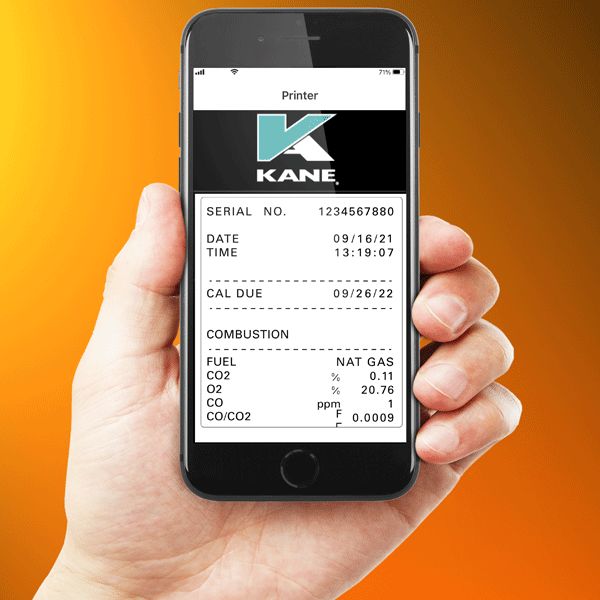
Skip the finicky thermal paper printers whose receipts run out mid-call or fade into blank strips on your van dashboard by July. The C165+ connects via Bluetooth to the free UEi HUB app on iOS and Android.
You can capture live combustion numbers right on your phone, add customer details, and attach a clean PDF report directly to your ServiceTitan or Housecall Pro invoice before you pack up your tools. It proves to the homeowner, and your service manager, that the equipment was left safe and properly tuned.
Advantages (Pros) and Limitations (Cons)
Advantages (Pros)
- 10,000 ppm EOS Optical CO Sensor: Survives nasty over-firing burners and cracked heat exchangers without sensor burnout, plus hydrogen compensation prevents false high readings.
- Simultaneous Manometer and Flue Testing: Built-in dual differential pressure ports let you watch 3.5-inch WC manifold pressure and flue CO move together on one screen.
- Glove-Friendly Rotary Dial: Tactile mechanical selector dial and rubberized buttons work reliably with dirty hands or thick winter work gloves.
- Automated Heat Exchanger CYA Mode: Tracks supply-air CO before and after blower startup to document heat exchanger breaches clearly.
- Instant PDF Reporting via UEi HUB: Exports digital combustion records straight to field service software without dealing with thermal printer paper rolls.
Limitations (Cons)
- Water Trap Needs Constant Attention: Condensing furnaces fill the inline water trap quickly, requiring you to mount the unit vertically and drain the trap after every job.
- Dial Bezel Traps Grime: Soot and pipe dope can build up around the mechanical rotary dial if you do not wipe it down regularly.
- Basement Bluetooth Range: Wireless connection to your phone can drop if you walk upstairs while leaving the analyzer behind thick concrete foundation walls.
Who Should Buy It, and Who Should Not?
Who Should Buy It
- Residential HVAC Service Technicians: Techs troubleshooting no-heat calls, clocking gas valves, and inspecting heat exchangers on 80% and 96% furnaces every day.
- Boiler Mechanics and Hydronic Specialists: Technicians tuning atmospheric and modulating-condensing boilers who need fast draft and excess air feedback.
- Light Commercial Maintenance Techs: Contractors servicing rooftop units, unit heaters, and commercial water heaters who want one analyzer that covers gas pressure and combustion.
- Home Performance and Safety Auditors: Inspectors documenting carbon monoxide compliance and draft safety for property managers and homeowners.
Who Should Not Buy It
- Heavy Industrial Emissions Technicians: Specialists testing power plant boilers or industrial kilns that require four-gas or five-gas analysis (SO2, NO2, H2S).
- Rough-In Install Crews: Installation helpers who only set equipment and leave startup and combustion calibration to dedicated commissioning techs.
- Occasional General Handymen: General repair workers without formal combustion training who rarely touch gas-fired heating appliances.
Is It Worth the Money?
The UEi C165+ sits squarely in the mid-tier professional analyzer bracket, representing an initial investment roughly equal to the billable revenue of five to seven standard residential diagnostic calls. To see how fast it pays back, look at two numbers every service manager tracks: sensor upkeep and billable minutes saved.
First, standard electrochemical analyzers force you to replace the CO sensor cell every two to three years. Each sensor replacement costs roughly one to two billable service calls, plus shipping fees and a week without your primary analyzer during peak heating season. The EOS optical sensor eliminates those recurring cell replacements for up to a decade.
Second, leaving your standalone manometer and dual thermometers in the van saves roughly 15 to 20 minutes per call when tuning gas valves and checking temperature rise. Across a busy winter week, those saved minutes easily free up enough time for an extra billable service call. Between eliminated sensor rebuilds, faster diagnostics, and documented heat exchanger safety reports that prevent callbacks, the UEi C165+ pays for itself well before your first heating season ends.
Technician Focused FAQs
1. Why is the EOS CO sensor better than a regular electrochemical CO cell?
Regular electrochemical cells use a chemical paste that wears out every time it sees carbon monoxide. A single encounter with a blocked flue above 2,000 ppm can permanently poison the cell. The EOS sensor measures CO with an infrared light beam, giving it a lifespan of up to ten years and allowing it to read up to 10,000 ppm without damage.
2. Can I adjust a gas valve while watching flue CO at the same time?
Yes. Connect a static pressure hose from the gas valve manifold tap to the differential pressure port on the C165+ while the flue probe sits in the stack. You can watch manifold pressure (such as 3.5 inches WC on natural gas) and live CO and O2 readings simultaneously while turning the regulator screw.
3. How do I avoid flooding the pump on a 96% condensing furnace?
High-efficiency condensing flue gas carries heavy moisture. Always attach the analyzer vertically to the furnace cabinet using the rear magnets so water stays at the bottom of the clear trap bowl. Never lay the meter flat on the floor, and pop the rubber drain plug to empty the trap after every single call.
4. How does the Heat Exchanger Integrity Test catch a small crack?
You place the probe in the supply air plenum above the indoor coil while the burners fire with the blower fan off. Once the analyzer logs a baseline, the indoor blower turns on and pressurizes the furnace cabinet. If combustion gases leak through a cracked cell or loose crimp ring into the airstream, the analyzer flags the CO spike immediately.
5. Can I add Nitric Oxide (NO) testing to the C165+ later?
Yes. The C165+ includes an internal expansion slot built for a plug-and-play Nitric Oxide sensor. If your company takes on commercial boiler contracts that require NOx readings, your distributor or UEi service center can install the sensor without replacing your meter.
Final Technician Verdict
The UEi C165+ Combustion Analyzer is built for real-world heating service, not laboratory showrooms. It solves the exact problems that slow technicians down in dark basements and freezing attics, combining a 10,000 ppm optical CO sensor, simultaneous manometer ports, glove-friendly rotary controls, and instant mobile PDF reporting in one tough housing.
If you service residential furnaces, hydronic boilers, or light commercial heating equipment, the UEi C165+ will make your diagnostics faster, safer, and far more reliable, and pay for itself through saved labor and zero sensor burnout headaches.