
Main page content
UEi C161 Combustion Analyzer Review: Residential HVAC Field Test
Executive Summary
When you kneel on a cold basement floor next to an atmospheric furnace on a Friday afternoon no-heat call, every tool must earn its keep. The main question every service technician asks is simple. Will this analyzer help diagnose or fix the problem faster, accurately, safely, and reliably, and is it worth the investment on my truck?
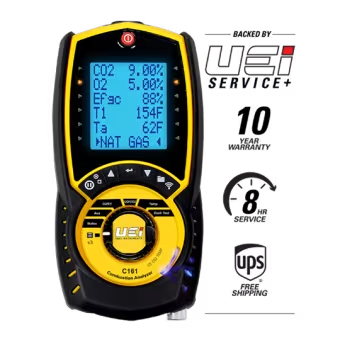
The UEi C161 Combustion Analyzer is built for residential HVAC technicians who want fast, dependable flue gas numbers without paying for commercial features they never touch. Traditional entry-level meters rely on an electrochemical oxygen (O2) sensor that quietly dies in your truck bag every 18 to 24 months. Instead, the C161 uses a direct Electro Optical Sensor (EOS) for Carbon Dioxide (CO2) and calculates O2 from there. That single design choice cuts down your long-term ownership headaches right out of the gate.
With a 30-second startup countdown, a built-in Heat Exchanger Test mode, and a NOx-filtered Carbon Monoxide (CO) sensor, the C161 covers daily calls cleanly. An over-range purge pump protects the CO cell, while dual K-type temperature inputs handle temperature rise checks. It skips built-in manometer ports and Bluetooth syncing to stay at an entry-level investment tier. This makes it a smart workhorse for residential service techs who already carry a digital manometer.
AZ Testers Technician Score
Product rating on a scale from 1 to 10 based on field testing across primary diagnostic categories:
- Performance: 8.6 / 10
- Accuracy: 8.9 / 10
- Ease of Use: 9.1 / 10
- Durability: 8.5 / 10
- Features: 8.0 / 10
- Safety: 9.0 / 10
- Value: 9.2 / 10
Overall Score: 8.8 / 10
AZ Testers Recommended
- Best for: Residential HVAC service technicians and tune-up specialists servicing gas, propane, and oil furnaces or boilers who already own a digital manometer.
- Best feature: Direct optical CO2 EOS sensor paired with a 30-second startup cycle, eliminating dead electrochemical O2 cells and long morning warm-up waits.
- Main weakness: No built-in differential pressure ports or Bluetooth app connectivity, so you still need a separate manometer for manifold pressure and draft checks.
- Upgrade path: Technicians servicing modulating commercial boilers or crews wanting built-in manometer ports and wireless PDF reporting should step up to the UEi C163 or UEi C165+.
Key Specifications At-A-Glance
The table below separates glossy datasheet claims from what actually matters when you stand in front of an open burner vestibule.
| Parameter / Spec | Manufacturer Specifications | Service Technician Field Impact |
|---|---|---|
| Direct Carbon Dioxide (CO2) EOS Sensor | 0.0% to 20.0% CO2, Accuracy: ±0.3% volume | Measures CO2 optically and calculates O2, eliminating the chemical O2 cell that dries out every two years. |
| Carbon Monoxide (CO) Sensor | 0 to 2,000 ppm (NOx-filtered electrochemical), Resolution: 1 ppm, Accuracy: ±3 ppm or ±5% rdg | Handles normal residential burner tuning cleanly, while the over-range purge pump protects the cell during high-CO spikes. |
| Calculated Oxygen (O2) | 0.0% to 21.0% O2, Accuracy: ±0.3% volume | Gives you reliable excess air and efficiency readings without worrying about an aging oxygen sensor drifting out of spec. |
| Flue and Inlet Temperature | Flue: 32°F to 1112°F (0°C to 600°C); External K-Type: -40°F to 950°F | Covers standard 80% metal flues, 96% condensing PVC vents, and supply-to-return temperature rise checks in one setup. |
| Startup and Purge Cycle | 30-second fresh-air countdown; automatic shutdown purge | Lets you power up while walking from the truck to the basement door so you are ready to probe immediately. |
| Pre-Programmed Fuels | 8 fuels (Natural Gas, Propane, LPG, Light Oil, Heavy Oil, Bio Oil, Pellets) | Lets residential techs switch from a city natural gas furnace to a rural LP conversion or oil boiler in seconds. |
| Power and Runtime | 3 Rechargeable AA NiMH batteries with Micro-USB charging, Over 8 hours continuous runtime | Runs all day with the pump active, and accepts standard AA alkaline batteries if you forget to charge overnight. |
| Data and Reporting | 30 internal memory positions; Infrared (IR) port for optional IRP-2 thermal printer | Stores readings on the meter for your ticket, though you must log numbers manually or buy the optional IR printer. |
Model Comparison
UEi builds its C160 series in clear tiers so you do not pay for sensors your daily route never requires. The table below compares the UEi C161, UEi C163, and UEi C165+ using relative investment tiers rather than fixed price tags.
| Feature / Capability | UEi C161 | UEi C163 | UEi C165+ |
|---|---|---|---|
| Primary CO Sensor Range | 0 to 2,000 ppm (Electrochemical, NOx-filtered) | 0 to 2,000 ppm (Electrochemical, NOx-filtered) | 0 to 10,000 ppm (EOS Optical CO Sensor with H2 compensation) |
| Direct CO2 EOS Sensor | Yes (Calculates O2) | Yes (Calculates O2) | Measures O2 directly, calculates CO2 |
| Differential Pressure (Manometer) | No | Yes (±80 mbar / ±32 inches WC) | Yes (±80 mbar / ±32 inches WC) |
| Heat Exchanger Integrity Test Mode | Yes | Yes | Yes |
| Wireless Mobile App Connectivity | No (IR Printer Port Only) | No (IR Printer Port Only) | Yes (Bluetooth to UEi HUB Mobile App) |
| Nitric Oxide (NO) Sensor Option | No | No | Yes (Field or Factory Upgradable) |
| Relative Investment Tier | Entry-Level Pro Tier (Approx. 3 to 4 residential calls) | Mid-Level Combo Tier (Approx. 4 to 6 residential calls) | Upper-Mid Commercial Tier (Approx. 6 to 8 residential calls) |
Pro Tip for Commercial Technicians: If your truck regularly pulls up to commercial rooftops, modulating-condensing boilers, or power burners, the UEi C161 will hit its ceiling fast. Commercial equipment requires simultaneous stack draft and gas manifold pressure verification, which the C161 lacks. Commercial burners also need higher CO headroom when tuning rich-firing equipment at ignition and low fire. Commercial mechanics should step up to the UEi C163 at minimum for built-in differential pressure, or go straight to the UEi C165+ for 10,000 ppm CO protection and instant Bluetooth PDF reporting. Regardless of which model you carry, never zero your analyzer inside a tight mechanical room next to running equipment. Always step outside into fresh air for the 30-second countdown.
What Problem Does This Product Solve?
Every residential HVAC tech knows the headache of traditional entry-level combustion analyzers. Most budget analyzers rely on two chemical sensors, an O2 cell and a CO cell, that degrade from day one. Even if your analyzer sits in its hard case all summer, you often find a dead O2 sensor error in October. Replacing that cell eats up the profit of one to two service calls and sidelines your meter during peak season.
At the same time, setting gas pressure and eyeballing a burner flame on modern furnaces is a recipe for callbacks. Without real flue numbers, you cannot tell if a secondary heat exchanger is plugging up or if an LP conversion is over-firing. You also risk missing a cracked heat exchanger dumping carbon monoxide into the supply ductwork.
The UEi C161 solves both problems for residential techs. By using an optical EOS sensor to measure CO2 directly and calculate O2, UEi removed the fragile chemical oxygen cell entirely. You get fast, accurate efficiency, excess air, and carbon monoxide readings in an entry-level package that stays ready season after season.
How Well Does It Solve It in the Field?
When you stand in a cramped utility closet or an unheated attic, speed and simplicity beat complicated menus every time. Hit the power button on the C161 while walking up the driveway, and the 30-second zero countdown finishes before you pull the furnace door off.
Once you slide the stainless steel probe into the flue test port, the six-line backlit display shows key parameters at once. You see CO, CO2, calculated O2, Flue Temperature, Inlet Temperature, and Efficiency on one screen. You never have to thumb through sub-menus while holding a hot flue probe and a flashlight.
Touchscreen and Ergonomics
Glass touchscreens belong on smartphones, not in greasy boiler rooms. When your fingers are covered in pipe dope, oil soot, or thick winter gloves, swiping a screen smears grime everywhere. Worse, capacitive screens force you to peel your gloves off in freezing attics.
The UEi C161 uses a classic multimeter-style rotary selector dial paired with tactile rubber pushbuttons. You can click from ambient zero to flue test, temperature differential, or heat exchanger mode by feel without looking down. The rubberized boot includes strong rear magnets that lock onto steel furnace cabinets, keeping both hands free for your stubby screwdriver.
Housing Durability and Included Key Parts
Inside the molded hard case, UEi packs hardware built for daily van storage rather than delicate lab work:
- CP2 Stainless Steel Flue Probe: Rigid probe wand with a sliding cone stop that locks firmly into a 1/2-inch stack hole without sagging.
- Clear Inline Water Trap and Particle Filter: High-efficiency 96% condensing furnaces push wet exhaust into your sample line fast. Always hang the C161 vertically by its rear magnet, never lay it flat on a floor, and drain the trap after every condensing call.
- Dual K-Type Thermocouple Inputs: Lets you hook up primary air and supply-to-return temperature clamps to verify furnace temperature rise alongside your flue test.
- 3x AA Rechargeable NiMH Power: Charges via Micro-USB cable in your truck, and accepts regular AA alkaline batteries from your glovebox if the pack ever dies mid-route.
Real-Time Work and Analytical Capabilities
While the C161 caps its electrochemical CO sensor at 2,000 ppm, UEi built smart protection into the pump circuit. If you probe a rollout-damaged furnace and CO spikes past the threshold, the over-range purge pump kicks in automatically. It dilutes the sample with fresh air to protect the CO cell from permanent poisoning. Low-flow detection also alerts you if a kinked hose or clogged filter blocks the sample stream.
The dedicated Heat Exchanger Test Mode provides reliable safety documentation on residential service calls. You drill a small test hole in the supply plenum above the indoor coil and fire the burners with the blower off. After logging a baseline, the meter watches the display when the main blower kicks on and pressurizes the cabinet. If a cracked cell leaks flue gas into the airstream, the C161 flags the CO rise immediately.
Data Management and Customer Reports
Data export is where the C161 shows its entry-level positioning. Unlike the higher-tier UEi C165+, the C161 does not include a Bluetooth radio to beam PDF reports to your phone. Instead, it stores up to 30 test logs in memory and uses an infrared window to print via the optional IRP-2 thermal printer.
In practice, most residential techs skip buying extra thermal paper rolls. You can simply snap a quick photo of the backlit screen with your phone camera and attach it to your digital invoice. It takes three seconds and gives the customer timestamped visual proof that their furnace was left safe and tuned.
Advantages (Pros) and Limitations (Cons)
Advantages (Pros)
- No Electrochemical O2 Cell to Burn Out: Direct optical CO2 EOS sensor calculates O2, saving you from recurring oxygen sensor replacements every two years.
- 30-Second Startup and Auto-Purge: Fast cold-start countdown gets you testing immediately, while automatic over-range pump protection shields the CO cell from sudden spikes.
- Glove-Friendly Rotary Dial and Strong Magnets: Multimeter-style selector knob and magnetic boot let you work hands-free in cramped closets and cold attics.
- Dedicated Heat Exchanger Integrity Mode: Tracks supply plenum CO before and after blower startup to catch and document cracked heat exchangers reliably.
- AA Battery Flexibility plus USB Charging: Runs over 8 hours on rechargeable NiMH cells and accepts standard AA alkaline batteries in an emergency.
Limitations (Cons)
- No Built-In Differential Pressure Ports: You still have to carry and hook up a separate digital manometer to check manifold gas pressure and flue draft.
- No Bluetooth Smartphone App: Lacks wireless connectivity to the UEi HUB app, relying on manual entry, screen photos, or an optional infrared printer.
- 2,000 ppm CO Ceiling: Sufficient for residential furnaces and water heaters, but too restrictive for heavy commercial or industrial boiler commissioning.
Who Should Buy It, and Who Should Not?
Who Should Buy It
- Residential HVAC Service Technicians: Techs running daily no-heat calls, seasonal tune-ups, LP conversions, and safety checks who already carry a digital manometer.
- Residential Oil and Gas Boiler Techs: Mechanics needing 8 pre-programmed fuel curves, including light oil, bio oil, natural gas, and propane, without paying for commercial sensors.
- Service Managers Outfitting Multiple Trucks: Contractors looking for a durable, low-maintenance analyzer backed by the UEi 10-year warranty program with annual recertification.
Who Should Not Buy It
- Commercial Boiler and Power Burner Specialists: Techs who need 10,000 ppm CO headroom, simultaneous draft and manifold pressure, and Nitric Oxide testing should step up to the UEi C165+.
- One-Tool Minimalists: Technicians who hate carrying a separate manometer and want gas pressure and flue gas on one screen should pick the UEi C163 instead.
- Paperless Digital Reporting Fanatics: Contractors who require automated Bluetooth PDF reports generated straight from an app without taking screen photos.
Is It Worth the Money?
The UEi C161 sits squarely in the entry-level professional analyzer bracket. Its initial investment equals roughly three or four standard residential diagnostic service calls. When you weigh what it saves you over five heating seasons, the math works strongly in your favor.
Because the C161 uses an optical EOS sensor for CO2 instead of a chemical oxygen cell, you avoid recurring replacements every 18 to 24 months. Furthermore, the over-range purge pump protects the NOx-filtered CO sensor from accidental high-CO spikes, keeping annual recertification predictable and affordable.
Even if you already own a solid dual-port manometer, adding the UEi C161 to your truck protects your bottom line. It lets you verify combustion efficiency, document heat exchanger safety, and catch carbon monoxide issues before they turn into callbacks. For residential heating technicians, it pays for itself quickly through faster troubleshooting and lower maintenance costs.
Technician Focused FAQs
1. Why does the UEi C161 not have an oxygen (O2) sensor?
Instead of using a chemical O2 sensor that degrades even while sitting in your truck, the C161 measures CO2 optically. The Electro Optical Sensor reads CO2 directly and calculates O2 mathematically. You still get accurate O2 and excess air readings without replacing a worn-out oxygen cell every two years.
2. Can I check gas valve manifold pressure with the UEi C161?
No. The C161 does not have built-in differential pressure ports. You must use your standalone digital manometer for manifold gas pressure and flue draft checks. If you want pressure and flue gas combined in one meter, step up to the UEi C163.
3. What happens if I stick the probe into a dirty furnace with over 2,000 ppm CO?
While the electrochemical CO sensor is rated up to 2,000 ppm, the C161 includes an automatic over-range purge pump. When CO climbs past the safe limit, the internal pump switches to fresh air dilution to protect the sensor from permanent damage.
4. How do I keep water from damaging the pump on a 96% condensing furnace?
High-efficiency condensing furnaces produce heavy moisture in the flue pipe. Always attach the C161 vertically to the furnace cabinet using its rear magnets so water collects at the bottom of the trap. Never lay the unit flat on the floor, and pop the rubber drain plug to empty the trap after every single call.
5. Does the UEi C161 connect to the UEi HUB smartphone app?
No. The C161 does not include Bluetooth wireless hardware. It stores up to 30 readings internally and supports an optional infrared thermal printer. Most technicians simply snap a photo of the backlit display with their phone to attach to the customer invoice.
Final Technician Verdict
The UEi C161 Combustion Analyzer nails the fundamentals that matter most to residential HVAC service technicians. It pairs a long-life optical CO2 sensor with a 30-second startup and over-range CO pump protection. Add glove-friendly rotary controls and a dedicated heat exchanger test mode, and it eliminates the biggest maintenance headaches of budget analyzers.
If you already carry a reliable digital manometer and focus on residential gas, propane, or oil heating equipment, the UEi C161 is an easy recommendation. It delivers accurate diagnostics, rock-solid safety verification, and low long-term ownership costs.