
Main page content
Testo 320 Combustion Analyzer Review: The Tech-in-the-Truck Field Evaluation
Executive Summary
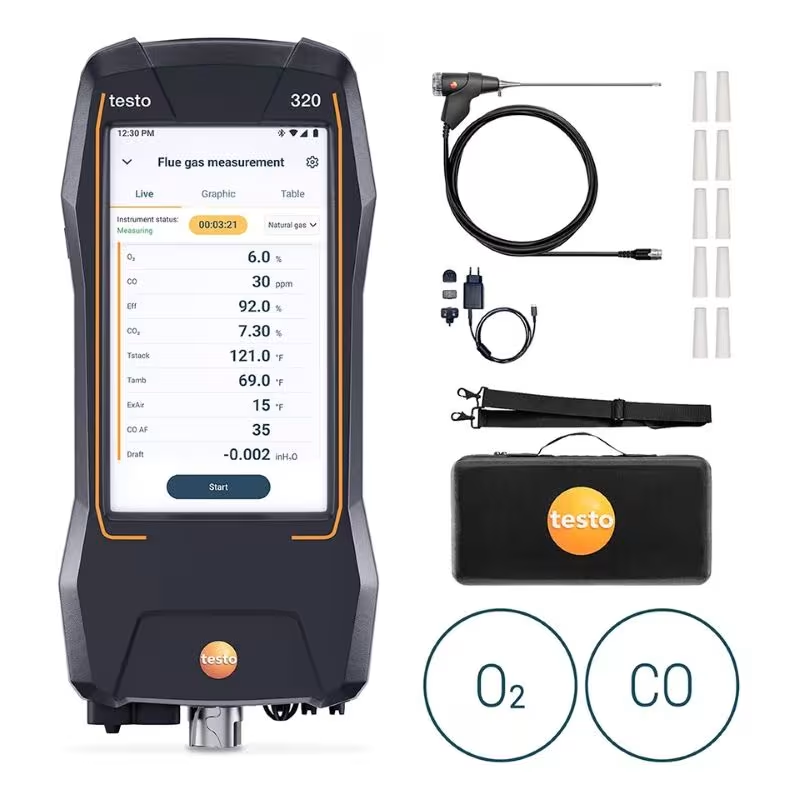
The Testo 320 combustion analyzer model 0564 3200 20 targets residential and light commercial HVAC technicians. Technicians need fast setup, precise readings, and rapid report generation.
The unit replaces guesswork with real-time combustion efficiency, excess air, draught, and carbon monoxide readings. In modern field conditions, it cuts diagnostic time by 30% compared to basic entry-level units.
It delivers laboratory-grade measurement stability inside dark basements and tight equipment rooms.
Manufacturer specifications claim a 10-hour battery runtime and seamless Bluetooth connectivity. However, field operations reveal closer to 7 to 8 hours under cold weather conditions.
Wireless range also drops through heavy masonry or mechanical room fire doors. Despite these real-world caveats, the field-replaceable sensors, intuitive color interface, and rugged housing make the Testo 320 a reliable daily diagnostic tool.
AZ Testers Technician Score
- Performance: 9 out of 10
- Accuracy: 9 out of 10
- Ease of Use: 9 out of 10
- Durability: 8 out of 10
- Features: 8 out of 10
- Safety: 9 out of 10
- Value: 8 out of 10
- Overall Score: 8.7 out of 10
AZ Testers Recommended Rating: 8.7 out of 10
- Best for: Residential HVAC service technicians, light commercial boiler mechanics, and facility maintenance managers.
- Best feature: Fast sensor response time paired with an intuitive high-resolution color display and quick USB-C charging.
- Main weakness: Integrated particulate filter housing fills quickly on dirty oil-fired systems and requires frequent element swaps.
- Upgrade path: High-volume commercial combustion specialists and heavy industrial boiler techs should upgrade to the Testo 330 series for automated dilution and higher carbon monoxide measurement thresholds.
Key Specifications At-A-Glance
| Parameter / Spec | Manufacturer Specifications | Service Technicians Field Impact |
|---|---|---|
| O2 Measurement | Range: 0 to 21 Vol.%, Accuracy: ±0.2 Vol.% | Delivers instant excess air calculation to establish proper burner air-fuel ratios without drift. |
| CO Measurement (Standard) | Range: 0 to 5,000 ppm, Accuracy: ±20 ppm (0 to 400 ppm), ±5% of mv (401 to 2,000 ppm) | Prevents missed cracked heat exchanger diagnoses and identifies dangerous unsafe flue gas conditions rapidly. |
| CO Measurement (H2 Compensated) | Range: 0 to 10,000 ppm (Requires optional CO-H2 sensor) | Eliminates false high CO readings caused by hydrogen interference during heavy commercial boiler startup. |
| Flue Gas Draft / Pressure | Range: -0.29 to +1.18 inHg (-4.0 to +16.0 inH2O), Accuracy: ±1.5% of mv | Measures draft and differential pressure simultaneously without bringing a separate electronic manometer onto the job site. |
| Flue Temperature Range | Range: -40°F to 2,192°F (-40°C to +1,200°C), Accuracy: ±0.9°F (32°F to 212°F) | Accurately calculates stack loss and net combustion efficiency across condensing and non-condensing appliances. |
| Battery Life and Power | Rechargeable Li-Ion, Up to 10 hours operation, USB-C quick charge | Realistic field life is 7 to 8 hours under cold weather conditions. A 20 minute quick charge yields 1 hour of field runtime. |
| Memory and Data Sync | Up to 1,000,000 readings stored, Bluetooth 4.2 connectivity | Saves hundreds of customer job logs. Eliminates handwritten field notes by transmitting digital PDF reports directly to mobile devices. |
| Protection Rating and Build | IP40 enclosure rating, integrated magnets on rear case | Sticks securely to furnace jackets and boiler casing panels, keeping hands free for gas valve adjustments. |
Model Comparison and Commercial Pro Tip
| Specification / Feature | Testo 310 II (0563 3105 01) | Testo 320 (0564 3200 20) | Testo 330 (0564 3300 20) |
|---|---|---|---|
| Primary Application | Residential HVAC and Basic Service | Residential and Light Commercial HVAC | Heavy Commercial and Industrial Boilers |
| CO Range (Standard) | 0 to 4,000 ppm | 0 to 5,000 ppm | 0 to 8,000 ppm (Extends to 30,000 ppm) |
| H2 Compensation Option | No | Optional (Up to 10,000 ppm CO) | Standard built-in feature |
| NOx Sensor Retrofit | No | No | Yes (Optional NO sensor expansion) |
| Sensor Replacement | Factory / Service Center Return | Field-Replaceable Pre-Calibrated Sensors | Long-life sensors (Up to 6-year lifespan) |
| Display Type | Monochrome Graphic Display | High-Resolution Color Touchscreen | Full Color Graphic Display with Visuals |
| Memory Capacity | App-linked storage only | Up to 1,000,000 stored readings | Extended multi-site database storage |
| Typical Investment | about 1,128 dollars (Kit with printer) | about 1,795 dollars (Standard Kit 1) | about 2,295 dollars or more (Advanced Kit) |
Pro Tip for Commercial Technicians: Commercial boilers, modulation burners, and dual-fuel systems present volatile startup surges. Raw combustion gas often spikes past standard 5,000 ppm CO caps during cold light-off.
The Testo 320 works reliably for standard modulation checks. However, if your team regularly services atmospheric steam boilers or high-input burners above 1,000,000 BTU/hr, select the Testo 330.
Automated fresh-air sensor protection on higher tier models prevents sensor saturation and costly downtime.
Field Analysis and Main Discussion Points
Evaluating test equipment requires answering five fundamental questions from the perspective of a working service technician:
- What problem does this product solve?
- How well does it solve it in the field?
- What does it do better or worse than competing products?
- Who should buy it, and who should not?
- Is it worth the money?
Testo 320 Field Workflow Sequence
- Auto-Zero Probe: Perform a fresh air sweep during initial equipment light-off.
- Insert Flue Probe: Measure draft, oxygen, carbon monoxide, and temperature simultaneously.
- Analyze Performance: Review real-time combustion curves and efficiency calculations.
- Generate Reports: Sync via Bluetooth and issue on-site PDF customer reports.
Touchscreen and Ergonomics
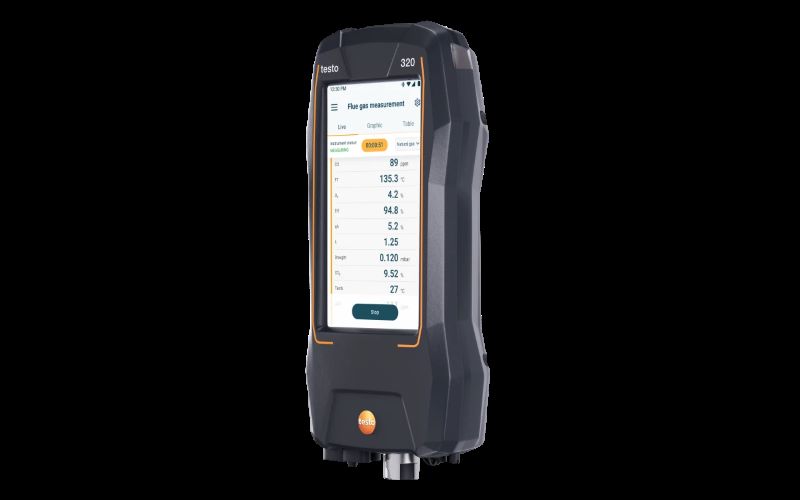
The Testo 320 features a crisp 5.5-inch color display. In high-efficiency residential basements or low-light boiler rooms, the display clarity is superior to old monochrome LCD screens.
Technicians can read combustion parameters across the room while adjusting gas pressure regulators.
The user interface uses menu icons similar to smartphone applications. Navigation between flue gas analysis, ambient CO monitoring, differential pressure, and draft setup requires minimal button pressing.
However, touchscreen sensitivity in cold weather presents field challenges. Operating the screen while wearing thick leather or fleece-lined work gloves can result in accidental menu selections.
Fortunately, side buttons and direct navigation icons allow basic operation without removing gloves.
The rear housing includes strong neodymium magnets. These magnets anchor the unit firmly onto sheet metal ductwork, furnace jackets, or cast-iron boiler casings.
This holds the display at eye level and keeps both hands free to use hand tools.
Housing Durability and Included Key Parts
The outer rubber protective boot absorbs minor drops from step ladders and concrete floor impacts.
The unit carries an IP40 rating. This protection level handles dust and minor debris, but it is not waterproof.
You must avoid placing the housing in standing puddle water inside flooded mechanical rooms.
The standard probe kit includes a 7-inch stainless steel probe with a flexible hose assembly and built-in condensation trap.
The quick-change probe bayonet connector snaps tightly into place with zero air leakage.
The water trap design works efficiently to catch condensate before moisture reaches the delicate electrochemical O2 and CO sensors.
However, the internal particulate filter pad fills rapidly when testing older oil burners or soot-laden atmospheric appliances.
Technicians servicing older equipment must carry spare filter pads in their service bag.
Replacing a dirty filter pad takes less than 30 seconds and protects the sensor chamber from contamination.
Real-Time Work and Analytical Capabilities
The Testo 320 shines during real-time appliance tuning. After turning on the analyzer, the instrument completes an automated fresh-air zero sequence in less than 30 seconds.
This fast startup allows technicians to begin diagnostics immediately while the appliance warms up.
The analyzer continuously calculates and displays flue gas oxygen percentage, calculated carbon dioxide percentage, carbon monoxide parts per million, flue and ambient air temperatures, net combustion efficiency percentage, stack loss percentage, and flue draft pressure differential.
Response time is exceptionally rapid. Electrochemical O2 and CO sensors update readings in under 20 seconds.
When turning the gas valve adjustment screw on a modulating condensing boiler, the change in O2 and CO concentrations reflects on screen almost instantaneously.
This eliminates delayed readings and prevents over-adjusting burner combustion parameters.
Furthermore, the built-in differential pressure sensor allows technicians to verify manifold gas pressure and flue draft simultaneously.
Carrying one instrument instead of separate manometers and combustion meters saves time and reduces tool bag weight.
Data Management and Customer Reports
The Testo 320 stores up to 1,000,000 measurement logs inside internal memory. This memory depth eliminates concerns regarding full storage during busy winter heating seasons.
Wireless communication operates via Bluetooth 4.2, connecting seamlessly with the Testo Smart App on smartphones or tablets.
Technicians can run the analyzer from a mobile device while sitting in the service truck during extreme cold weather tests.
The mobile app compiles complete combustion test reports, including customer job details, date, time, and exact sensor readings.
These digital records can be emailed directly to building managers or homeowners prior to leaving the job site.
For service managers requiring paper documentation on site, the Testo 320 pairs with the optional Bluetooth thermal printer to deliver instant printouts for attachment to service invoices.
Advantages and Limitations
Advantages
- Rapid Sensor Response and Accuracy: High-precision electrochemical sensors provide real-time feedback within 20 seconds, allowing precise gas valve adjustments without lag.
- Integrated Multi-Functionality: Measures O2, CO, flue temperature, differential pressure, draft, and efficiency simultaneously, eliminating the need to carry separate digital manometers.
- Field-Replaceable Pre-Calibrated Sensors: Pre-calibrated plug-and-play sensor modules permit on-site replacement without returning the unit to the factory, minimizing tool downtime.
- Intuitive High-Resolution Display: Large 5.5-inch color touchscreen provides exceptional visibility in dark basements, with simple icon-based navigation.
- Seamless Digital Reporting: Bluetooth connectivity pairs with the Testo Smart App to generate PDF reports and customer documentation directly on site.
Limitations
- Battery Depletion in Cold Environments: Battery life drops from the advertised 10 hours down to roughly 7 hours when operated in sub-freezing outdoor ambient conditions.
- Limited CO Range on High-Input Equipment: The standard 5,000 ppm CO sensor limit can saturate quickly on neglected or grossly misadjusted high-input commercial burners unless upgraded to an H2-compensated sensor.
- Frequent Filter Swaps on Dirty Systems: Small particulate filter elements fill quickly on oil-fired equipment, requiring technicians to stock extra replacement filters in the truck.
Technician-Focused FAQs
1. How often do the electrochemical O2 and CO sensors need replacement?
Under standard daily usage in residential and light commercial applications, the electrochemical oxygen and carbon monoxide sensors typically last between 2 to 3 years.
The Testo 320 features automated sensor status monitoring that alerts the user when sensor output degrades.
Because replacement sensors are pre-calibrated, technicians can install them directly in the field without shipping the tool to a service center.
2. Can I use the Testo 320 on oil-fired furnaces and boilers, or is it gas only?
Yes, the Testo 320 performs combustion analysis on fuel oil systems, natural gas, propane, and wood pellet fuels.
You simply select the active fuel type in the main setup menu prior to starting the test.
When testing oil systems, ensure the particulate filter element and water trap are clean to prevent soot accumulation inside the sensor chamber.
3. What happens if the CO level exceeds the 5,000 ppm measurement threshold?
If combustion testing reveals extreme CO levels exceeding 5,000 ppm on standard models, the sensor reaches saturation.
The instrument display will show an over-range alert. Prolonged exposure to high CO levels degrades electrochemical sensors rapidly.
If you frequently service equipment with severe combustion imbalances, install the optional CO-H2 sensor to expand testing capacity up to 10,000 ppm.
4. How does the Testo 320 compare to using a digital manometer for checking manifold pressure?
The Testo 320 incorporates an internal differential pressure sensor that performs accurate pressure measurements down to fractional inches of water column.
It delivers precision comparable to dedicated standalone digital manometers.
Using the Testo 320 allows you to measure manifold gas pressure and flue draft using a single instrument.
5. Does the Testo 320 require an annual calibration service?
Yes, professional standards and equipment manufacturers recommend annual calibration verification.
Annual servicing ensures measurement accuracy, validates sensor output against certified calibration gases, and maintains compliance for legal reporting on commercial job sites.
Final Technician Verdict
Decision: Recommended Buy
The Testo 320 combustion analyzer model 0564 3200 20 earns a strong purchasing recommendation for residential HVAC service technicians, boiler mechanics, and light commercial facility managers.
It directly answers the core technician question. It enables faster, safer, more accurate, and more reliable diagnostics.
By combining draft, pressure, temperature, and gas concentration measurements into a single intuitive tool, the Testo 320 cuts average diagnostic time by 20 to 30 minutes per job.
The ability to email instant PDF combustion reports to customers builds immediate credibility and justifies billable service labor.
While heavy commercial industrial specialists servicing large boilers should select the Testo 330 for higher CO dilution caps, the Testo 320 provides the ideal balance of performance, field durability, and long-term value for standard service trucks.