
Main page content
Choosing the Right Armada Cable and Wire Locator: Pro871C vs. Pro881 vs. Pro900
Executive Summary
When an irrigation control wire severs or a lost solenoid valve hides beneath dry turf, guessing where to dig wastes precious billable hours. Professional irrigation contractors and utility locators rely on heavy duty diagnostic tools to trace paths accurately without tearing up lawns. This comprehensive comparison evaluates three leading models from Armada Technologies: the Pro871C, the Pro881, and the Pro900. By analyzing how each model handles raw output voltage, signal frequency, and electrical interference in real world conditions, you can determine exactly which unit fits your operational needs and budget.
The Core Technician Dilemma: Specs Versus Field Reality
Manufacturer brochures list impressive maximum ranges and voltage outputs, but field conditions tell a different story. Dry desert earth, rocky subsoil, and buried utilities absorb tracking signals rapidly. Furthermore, commercial properties introduce heavy electrical interference from transformers and lighting grids. A tool that performs well on a short residential test bench can fail completely on a sprawling industrial complex. Evaluating these three locators requires looking past the spec sheet and focusing on field performance.
Model-by-Model Field Breakdown
1. Armada Pro871C: The Versatile Commercial Workhorse
The Pro871C is designed as an all around tracking solution for everyday irrigation and cable locating tasks. It features dual direct connect frequencies at 2 kHz and 33 kHz, plus a 175 kHz inductive broadcast mode and passive 50/60 Hz power tracing. Coming standard with the IC4 inductive clamp, it allows technicians to induce signals onto wires without direct metallic contact. It is the ideal baseline unit for standard commercial properties and multi zone turf systems, balancing performance and ease of use.
- Best for: General irrigation contractors and landscape service crews handling standard commercial and residential properties.
- Key Advantage: Includes the inductive clamp for non contact signal injection right out of the box.
- Limitation: Relies on standard analog filtering, which can struggle in dense urban environments with severe electrical noise.
2. Armada Pro881: The High-Voltage Distance Specialist
When you face long institutional runs, sprawling golf course fairways, or dry, high resistance soils that swallow standard signals, the Pro881 provides brute force. It delivers a massive 900V peak to peak no load output. That extreme voltage punches a strong signal through miles of stubborn ground where weaker transmitters fail completely. It operates on proven 2 kHz and 33 kHz direct frequencies, focusing entirely on raw distance and signal penetration.
- Best for: Technicians working on expansive sports complexes, golf courses, and long rural utility runs.
- Key Advantage: Massive 900V output voltage overcomes dry soil resistance and extreme wire lengths.
- Limitation: Lacks advanced digital signal processing, meaning it is built for distance rather than heavy electrical interference rejection.
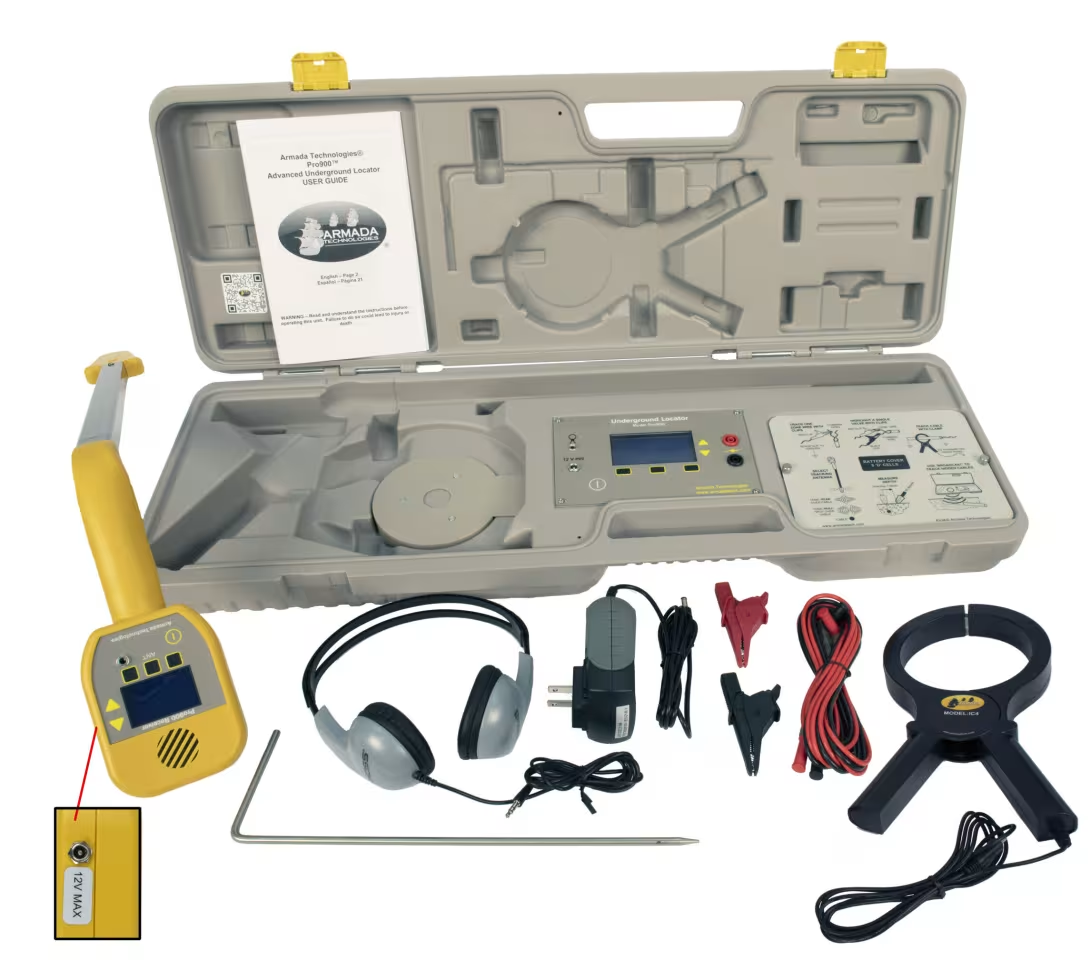
3. Armada Pro900: The Advanced Digital Powerhouse
The Pro900 represents the top tier of Armada diagnostic equipment, combining raw output power with advanced Digital Signal Processing. Instead of relying solely on analog audio tones, it uses selectable digital frequencies and sophisticated noise rejection filters. It separates your target signal from ambient electrical hum generated by nearby power transformers. With a five thousand foot range and eight foot depth capability, it handles complex commercial sites where other locators generate false positives.
- Best for: Master electricians, commercial contractors, and municipal crews working in congested urban areas.
- Key Advantage: Advanced digital filtering completely removes electrical hum and background noise.
- Limitation: Higher purchase price and advanced menu options require a steeper learning curve.
Side-by-Side Comparison Matrix
| Parameter / Spec | Armada Pro871C | Armada Pro881 | Armada Pro900 |
|---|---|---|---|
| Primary Application | General irrigation and cable tracking | Long distance and high resistance soil tracing | Advanced digital filtering and multi utility locating |
| Voltage / Output | Standard commercial output | 900V peak to peak no load output | High output digital transmitter |
| Tracking Frequencies | 2 kHz, 33 kHz Direct; 175 kHz Inductive | 2 kHz, 33 kHz Direct; 175 kHz Inductive | Multi frequency digital DSP suite |
| Noise Rejection | Standard analog audio filtering | Enhanced analog suppression | Advanced Digital Signal Processing |
| Included Accessories | Standard with IC4 inductive clamp | Heavy duty leads and ground stake | Comprehensive kit with inductive clamp and digital receiver |
Field Scenarios: Which Tool Should You Buy?
- Choose the Pro871C if: Your daily work involves standard commercial and residential irrigation repair, and you want a dependable, versatile locator that includes an inductive clamp without paying for advanced digital features.
- Choose the Pro881 if: Your biggest frustration is signal attenuation over long distances, large turf expanses, or dry soil conditions where brute force voltage is the only way to close the circuit.
- Choose the Pro900 if: You operate in congested commercial or urban environments where electrical interference causes false readings, or if you need an all in one tool for both irrigation wires and general utility cables.
Final Technician Verdict
Investing in the right wire and valve locator transforms a frustrating, speculative dig into a precise, profitable repair. While the Pro871C offers balanced everyday value, the Pro881 solves distance and soil resistance, and the Pro900 conquers electrical noise. Match your primary jobsite challenges to the correct model to ensure maximum return on investment.