
Main page content
UEI CD100A Combustible Gas Detector Review
Executive Summary
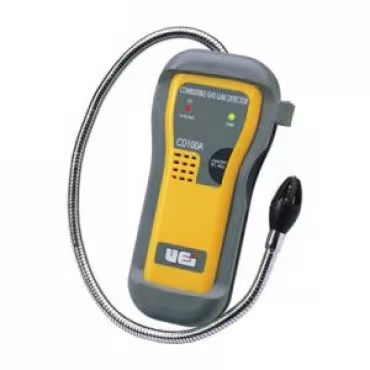
The UEi CD100A Combustible Gas Leak Detector is an industry-standard sniffer built for residential HVAC technicians, boiler mechanics, and light commercial gas fitters. It detects methane, propane, natural gas, and alternative refrigerants down to 50 ppm. Featuring an 18-inch flexible gooseneck probe, an illuminated sensor tip, and a fully adjustable analog tic-rate thumbwheel, the CD100A lets you isolate hairline fitting leaks and cracked heat exchangers fast. While it lacks digital PPM displays and eats through 9V batteries faster than modern lithium units, its rugged rubber boot and instant response make it a reliable "first-out-of-the-bag" diagnostic tool for every service van.
AZ Testers Technician Score
| Category | Score (1–10) |
|---|---|
| Performance | 8.0 / 10 |
| Accuracy | 8.0 / 10 |
| Ease of Use | 9.0 / 10 |
| Durability | 8.0 / 10 |
| Features | 7.0 / 10 |
| Safety | 8.0 / 10 |
| Value | 9.0 / 10 |
| Overall Score | 8.1 / 10 |
AZ Testers Recommended
- Best for: Residential HVAC service techs, plumbers, and boiler mechanics performing routine gas line check-outs, furnace commissioning, and seasonal tune-ups.
- Best feature: 18-inch gooseneck combined with a manual thumbwheel tic-rate adjustment for rapid micro-leak isolation in cramped cabinets.
- Main weakness: Short 5-hour battery life on standard 9V alkaline cells and no digital PPM concentration readout.
- Upgrade path: Commercial combustion specialists needing visual LED concentration arrays, dual-sensitivity modes, or digital LEL/PPM displays should look toward commercial-grade multi-gas analyzers or industrial-grade leak sniffers like the Bacharach Leakator 10.
Key Specifications At-A-Glance
| Parameter/Spec | Manufacturer Specifications | Service Technicians Field Impact |
|---|---|---|
| Sensor Type | Solid-State Semiconductor | Provides instant warm-up and fast sensing without requiring expensive sensor recalibration field kits. |
| Minimum Sensitivity | 50 PPM (Methane) | Catches tiny gas seepages before they become hazardous odor complaints or ignition risks. |
| Probe Length | 18 Inches (400 mm) Flexible Gooseneck | Reaches around furnace draft inductors, behind water heaters, and into deep ductwork pockets. |
| Tic Rate Control | Fully Adjustable Analog Thumbwheel | Allows you to lower background tick speed in gas-saturated spaces to zero in on the exact leak source. |
| Visual Alarm | Flashing LED Sensor Tip & Body Light | Gives immediate visual feedback when working inside dark crawlspaces, attics, or mechanical closets. |
| Audible Alarm | Variable Tic Speed with 3.5mm Earphone Jack | Enables leak pinpointing inside noisy boiler rooms without ambient plant noise blocking the audio pitch. |
| Power & Runtime | 9V Alkaline Battery (~5 Hours Continuous Use) | Runs on standard truck stock, but requires keeping spare 9V batteries handy in your instrument bag. |
| Target Gases | Natural Gas, Propane, Isobutane (R600a), R290, Solvents | Multi-gas detection capabilities cover heating gas, industrial solvents, and flammable A2L/hydrocarbon refrigerants. |
Pro Tip for Commercial Technicians
Commercial Field Tip: Solid-state semiconductor sensors like the one in the CD100A react to total VOC concentrations, including pipe dope vapors, cutting oils, refrigerant drift, and alcohol cleaning sprays. When testing threaded black iron fittings inside tight commercial boiler rooms, purge the sensor in fresh outdoor air first. Set your thumbwheel to a slow 1-to-2 ticks per second baseline before sweeping the pipe joints. If the unit alerts, confirm the leak with bubble solution before breaking down piping connections.
Field Analysis & Work Performance
Touchscreen & Ergonomics
The UEi CD100A skips digital screens and touch menus in favor of rugged, single-handed analog controls. You get a tactile thumbwheel dial mounted right where your thumb rests during single-handed operation. Spinning the wheel turns the unit on and adjusts the tick frequency.
The 18-inch gooseneck holds its shape when bent into compound angles, letting you snake the tip behind B-vent piping, heat exchanger cells, and tight gas manifold valves. The sensor cap features a built-in tip light that illuminates dark burner orifices and pipe threads without needing a separate flashlight in your free hand.
Control & Probe Architecture:
- 18" Flexible Gooseneck: Positionable tip with integrated LED illumination cap.
- Flashing LED Indicator: Visual alert on body and tip.
- Thumbwheel Tic Dial: Thumb-controlled single-handed power switch and sensitivity baseline adjustment.
- 3.5mm Headphone Jack: Side audio port for high-decibel mechanical rooms.
- Rubber Protective Boot: Full overmolded sleeve for drop protection.
Housing Durability & Included Key Parts
The detector comes enclosed in a yellow rubber protective boot that absorbs drop impacts on concrete boiler room floors. The housing protects the internal circuit board against moisture and tool-bag abuse.
Key included parts:
- Removable Sensor Cap: Protects the solid-state element while housing the tip-light optic lens.
- Protective Rubber Sleeve: Wraps around the main body to prevent slipping off wet furnace cabinets.
- 9V Alkaline Battery: Powers the unit out of the box.
Note: For long-term protection, pick up the optional AC519 soft padded carrying case to prevent the gooseneck from getting crushed under heavier tools in your truck stack.
Real-Time Work & Analytical Capabilities
In the field, the CD100A operates as a relative concentration sniffer. Warm-up time takes roughly 10 to 20 seconds. Once warmed up, you dial the thumbwheel until you hear a steady background tick rate (similar to a Geiger counter).
As the sensor approaches a gas fitting leak, the tick frequency accelerates rapidly, accompanied by a bright flashing LED on the body and tip.
- Micro-Leak Pinpointing: When approaching a suspected fitting, adjust the thumbwheel back down to slow the tick rate. Moving closer to the leak source will cause the rate to jump again, pinpointing leaks down to 50 ppm.
- Noisy Environment Work: In loud mechanical rooms with running draft blowers or rooftop compressors, plug standard earbuds into the side 3.5mm headphone jack to hear tick rate variations clearly.
Data Management & Customer Reports
The CD100A is a direct-reading analog tester with no onboard data logging, Bluetooth connectivity, or report-building software. Field reporting relies on technician verification:
- Identify the gas leak location using the CD100A tic-rate acceleration.
- Verify the bubble formation on threads using non-corrosive gas leak detection fluid.
- Document pipe size, location, and repaired condition directly into your mobile dispatch or service ticketing software.
Advantages & Limitations
Advantages (Pros)
- High Sensitivity: Detects combustible gas concentrations down to 50 ppm for early leak detection.
- Flexible 18-Inch Gooseneck: Reaches around tight furnace components, heat exchangers, and water heater burners.
- Lighted Sensor Tip: Illuminates dark crawlspaces and burner compartments while inspecting fittings.
- Analog Thumbwheel Tic Control: Allows fine-tuning of background sensitivity in gas-saturated environments.
- Headphone Jack Integration: Permits accurate leak detection in high-decibel industrial and commercial settings.
Limitations (Cons)
- High Battery Consumption: 9V battery runtime averages ~5 hours, requiring regular battery swaps.
- No Numerical Concentration Readout: Does not display exact LEL percentage or digital PPM levels.
- Potential VOC Cross-Sensitivity: Reacts to pipe thread sealant vapors, solvents, and cleaning sprays.
Technician FAQs
1. What gases can the UEi CD100A detect in the field?
The solid-state semiconductor sensor detects Natural Gas (Methane), Propane (LPG), Isobutane, Gasoline, Hydrogen Sulfide, Ammonia, Industrial Solvents, and hydrocarbon refrigerants like R290 and R600a.
2. How do I clear false positives caused by pipe dope or solvents?
Purge the sensor head in fresh outdoor air for 30 seconds. Bring the detector near the joint and adjust the tic-rate thumbwheel to a low baseline tick. If the tic speed jumps sharply right at the joint, confirm with soap bubbles.
3. Can I use the CD100A to inspect furnace heat exchangers for cracks?
Yes. Insert the flexible probe tip into the supply plenum or burner ports while the draft blower runs. A sudden rise in tick rate indicates flue gas leakage or unburned fuel passing through a cracked exchanger block.
4. How often does the solid-state sensor need replacement?
Under normal residential and light commercial use, the solid-state sensor element lasts 2 to 3 years. Replace the cap if the sensor becomes contaminated by liquid leak detection fluid or heavy oil.
5. Why is my CD100A ticking rapidly as soon as I turn it on?
The sensor requires a brief warm-up period (typically 10 to 30 seconds) to reach operating temperature. If it continues rapid ticking in clean air after warm-up, adjust the thumbwheel downward to reset the baseline tic rate.
Final Technician Verdict
Verdict: BUY
The UEi CD100A is a dependable, high-value addition to any service technician's tool arsenal. While it doesn't offer digital logging or multi-gas PPM readout displays found on high-end combustion analyzers, it excels at its core job: rapidly finding combustible gas leaks in tight spaces. Its 18-inch gooseneck probe, illuminated tip light, analog tic adjustment, and rugged rubber boot make it a workhorse for residential HVAC techs, plumbers, and light commercial mechanics. Keeping one in your diagnostic bag ensures fast, reliable gas line leak isolation on every call.